Beginner Home Circuit Workout: 8 No-Equipment Moves
An 8-move, no-equipment home circuit for beginners with timed rounds, form cues, easier and harder options, and an honest look at belly fat.
This circuit strings together eight no-equipment moves with equal work and rest periods, so you train strength and get your heart rate up in one short session. It’s built for beginners working out in a small space at home, with no jumping required and an easier and harder option for every move.
A quick word on belly fat
You can’t burn fat from your stomach by working your stomach. In a six-week study published in the Journal of Strength and Conditioning Research, sedentary adults did seven abdominal exercises five days a week. Their core endurance improved, but their abdominal fat, waist size and body fat percentage didn’t change significantly compared with a group that didn’t exercise.
Harvard Health makes the same point: sit-ups can tighten your abdominal muscles, but they won’t target the deeper visceral fat around your organs. What does help is regular moderate activity, strength training, a balanced diet and enough sleep.
So treat this circuit as one part of a bigger picture, alongside regular walking and steady eating habits. When fat loss happens, it happens across your whole body, in a pattern you can’t choose.
How the circuit works
Each move lasts 30 seconds, followed by 30 seconds of rest. The American Council on Exercise notes that a 1:1 work-to-rest ratio is an appropriate way for newer exercisers to start circuit training. One round of eight moves takes 8 minutes. Rest 1 to 2 minutes between rounds.
Warm up for 5 minutes first: march in place, roll your shoulders, swing your arms, circle your hips and do 10 slow half squats.
| Exercise | Sets | Reps or time | Rest |
|---|---|---|---|
| High-knee march | 2–3 rounds | 30 sec | 30 sec |
| Bodyweight squat | 2–3 rounds | 30 sec | 30 sec |
| Incline push-up | 2–3 rounds | 30 sec | 30 sec |
| Step jack | 2–3 rounds | 30 sec | 30 sec |
| Glute bridge | 2–3 rounds | 30 sec | 30 sec |
| Incline mountain climber | 2–3 rounds | 30 sec | 30 sec |
| Alternating reverse lunge | 2–3 rounds | 30 sec | 30 sec |
| Knee side plank | 2–3 rounds | 15 sec per side | 1–2 min (end of round) |
Cool down with 3 minutes of slow marching, then stretch your quads, hamstrings, hips and chest for about 20 seconds each.
High-knee march
- Stand tall and lift one knee toward hip height, then the other.
- Swing your arms in rhythm with your legs.
- Land softly on the balls of your feet.
Easier: march at a comfortable height and pace. Harder: speed up into a light jog in place.
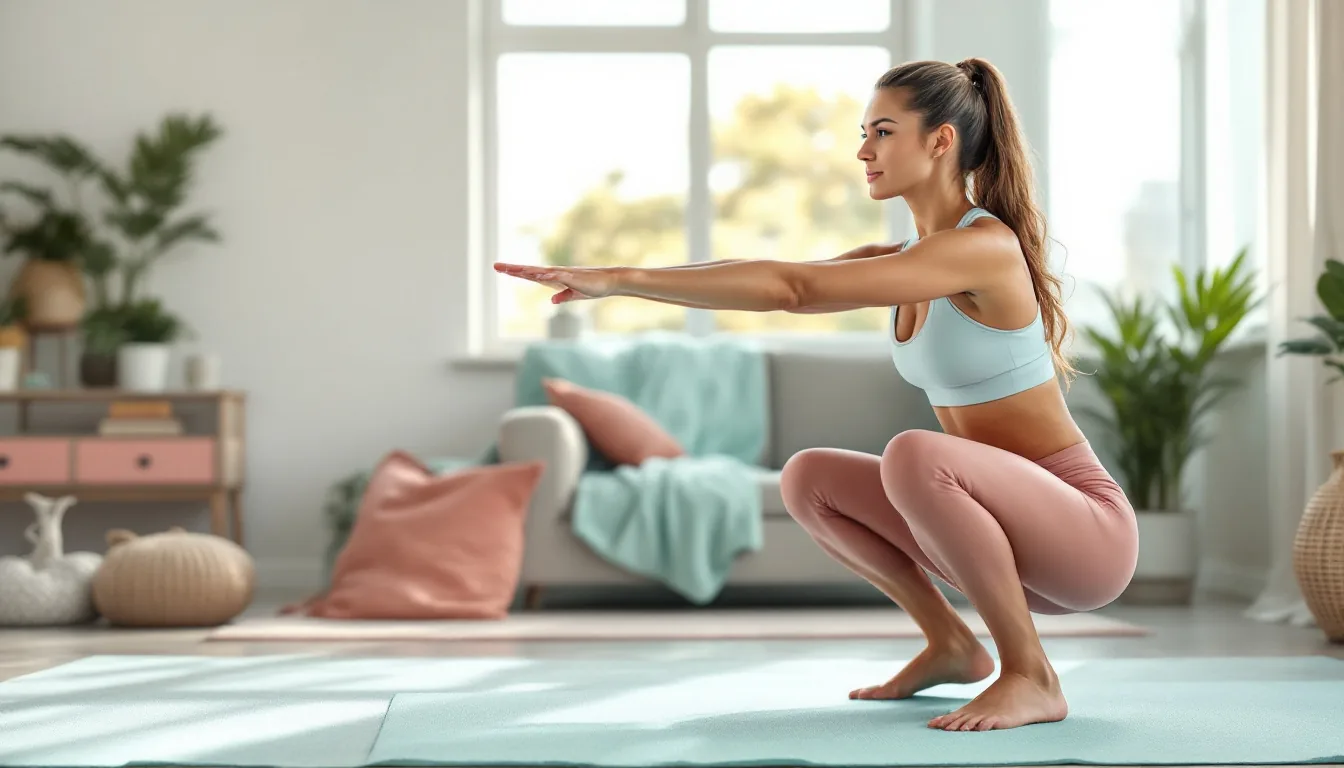
Bodyweight squat
- Stand with feet just wider than hip-width, toes turned out slightly.
- Sit your hips back and down, knees tracking over your toes.
- Keep your chest lifted and push through your whole foot to stand.
Easier: squat to a chair. Harder: pause for 2 seconds at the bottom of each rep.
Incline push-up
- Place your hands on a counter, table or sturdy chair, slightly wider than your shoulders.
- Hold a straight line from your head to your heels.
- Lower your chest to the edge, then press away.
Easier: use a wall. Harder: use a lower surface, or do push-ups from your knees on the floor.
Step jack
- Stand with feet together and arms by your sides.
- Step one foot out to the side as you raise both arms overhead.
- Return to center and repeat on the other side.
Easier: raise your arms only to shoulder height. Harder: switch to regular jumping jacks if your joints and pelvic floor are comfortable with impact.
Glute bridge
- Lie on your back with knees bent and feet flat on the floor.
- Press through your heels to lift your hips until they line up with your shoulders and knees.
- Squeeze your glutes at the top, then lower with control.
Easier: lift only halfway. Harder: march one foot off the floor at a time while holding the top position.
Incline mountain climber
- Place your hands on a sturdy chair, couch arm or counter in a high plank position.
- Drive one knee toward your chest, then switch legs.
- Keep your hips level and your shoulders over your hands.
Easier: step each foot in slowly. Harder: move your hands to the floor and pick up the pace.
Alternating reverse lunge
- Step one foot back and lower until both knees bend comfortably.
- Keep your torso upright and your front knee over your ankle.
- Push through your front foot to return, then switch legs.
Easier: hold a chair for balance and shorten the step. Harder: add a knee drive at the top of each rep.
Knee side plank
- Lie on your side with your elbow under your shoulder and knees bent.
- Lift your hips so your body forms a straight line from head to knees.
- Hold for 15 seconds, then switch sides.
Easier: lift and lower your hips for reps instead of holding. Harder: straighten your legs and balance on your feet.
How often to do it and how to progress
Do the circuit two or three times a week on non-consecutive days. On other days, walk. The CDC recommends at least 150 minutes of moderate activity and two days of muscle-strengthening a week, and this plan helps you build toward both.
| Week | Rounds | Work / rest |
|---|---|---|
| Week 1 | 2 | 30 sec / 30 sec |
| Week 2 | 3 | 30 sec / 30 sec |
| Week 3 | 3 | 40 sec / 20 sec |
| Week 4 | 3–4 | 40 sec / 20 sec, using the harder option on 2–3 moves |
How to scale it
To make the whole session easier, switch to 20 seconds of work and 40 seconds of rest, do one round and use a chair for support on squats and lunges. To make it harder, take the harder option on each move, cut rest between rounds to one minute or add a fourth round.
Safety
This is general information, not medical advice. If you’re pregnant or postpartum, have a health condition or notice any leaking, pelvic heaviness or pain, check with your doctor or a pelvic health physio and stick with the low-impact options. Stop any move that causes sharp or joint pain.
FAQs
How many calories does this circuit burn?
It depends on your body size and how hard you work. Harvard Health estimates 30 minutes of moderate calisthenics burns about 135 calories at 125 pounds, 162 at 155 pounds and 189 at 185 pounds. Vigorous effort raises that to roughly 240 to 336. Because this circuit includes rest breaks, a beginner session will likely sit toward the lower end.
Can I do this circuit every day?
You’ll recover and progress better with a rest day between sessions. Walk or stretch on the days in between.
Should I add crunches?
You can if you enjoy them, since they build abdominal endurance. Just don’t expect them to burn belly fat. Overall activity, nutrition and sleep do that job.
Sources
- Vispute et al. (2011), The Effect of Abdominal Exercise on Abdominal Fat, Journal of Strength and Conditioning Research
- Harvard Health: Taking Aim at Belly Fat
- ACE: Creating Effective Circuit Workouts
- Harvard Health: Calories Burned in 30 Minutes for People of Three Different Weights
- CDC: Physical Activity Guidelines for Adults
General information only, not medical advice. Stop if you feel pain, dizziness or shortness of breath, and check with a health professional before starting if you have any concerns.