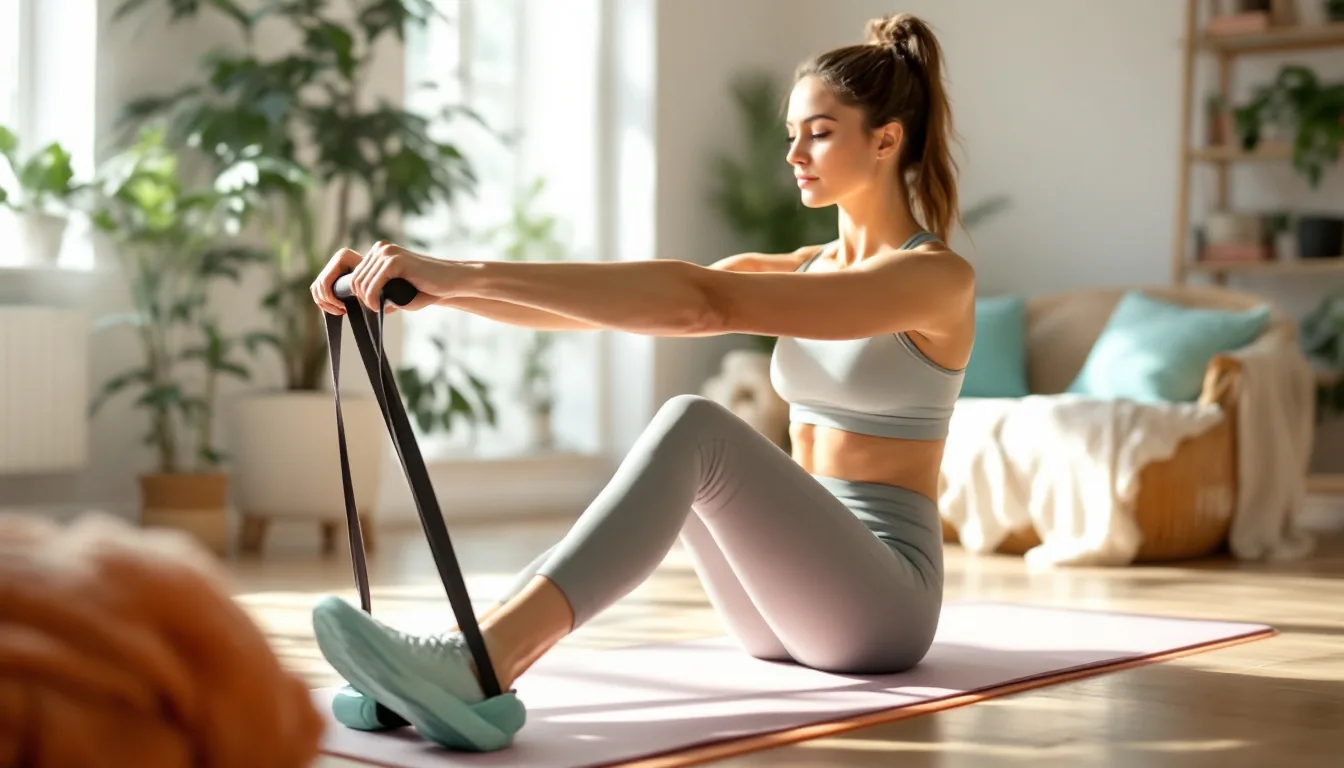
30-Day Back Challenge for Better Posture and Strength
A 30-day upper-back plan with band or dumbbell options, short sessions and simple desk habits to help you sit and stand more comfortably.

This 30-day challenge strengthens your upper back, rear shoulders and neck with a 20-minute routine you do three or four times a week. It’s built for beginners, especially if you spend long hours at a desk or looking down at a phone, and it works with either a resistance band or a pair of light dumbbells.
What posture training can and can’t do
There’s no single “perfect” posture. A 2019 viewpoint in the Journal of Orthopaedic & Sports Physical Therapy points out that the popular belief that sitting, standing or bending “incorrectly” causes back pain isn’t backed by strong evidence. What tends to cause trouble is staying stuck in one position. The NHS lists long stretches at a desk as a common trigger for neck pain and advises against keeping your neck in the same position for too long.
That doesn’t make back training pointless. In a randomized trial of 48 women with chronic neck muscle pain from computer-heavy jobs, 20-minute dumbbell sessions three times a week (including rows and reverse flys) cut their worst pain scores by about 79% over 10 weeks. A 2024 meta-analysis of 22 studies in people with forward-head and rounded-shoulder posture found that exercise programs improved forward head position, rounded shoulders and upper-back rounding, with combined strengthening and stretching working best.
So set the right goal: a stronger upper back that copes better with long days, plus a habit of moving more often. Not a ruler-straight spine.
The workout
You’ll need a light or medium resistance band (or light dumbbells), a mat and a clear patch of wall. Warm up for 3 to 5 minutes with shoulder rolls, arm circles, cat-cow and marching on the spot. Then work through the moves in order.
| Exercise | Sets | Reps or time | Rest |
|---|---|---|---|
| Band pull-apart | 2–3 | 12–15 | 30 sec |
| Bent-over row | 2–3 | 10–12 | 45 sec |
| Reverse fly | 2–3 | 10–12 | 45 sec |
| Prone Y-T raise | 2 | 6 of each letter | 30 sec |
| Superman hold | 2–3 | 5 holds of 5 sec | 30 sec |
| Bird dog | 2 | 8 per side | 30 sec |
| Wall slide | 2 | 10 | 30 sec |
| Chin tuck | 2 | 10 (3-sec hold) | 20 sec |
Cool down with a doorway chest stretch (30 seconds per side), child’s pose and a gentle side-of-neck stretch.
How to do each move
Band pull-apart. Hold the band at shoulder height, arms straight and hands shoulder-width apart. Pull it toward your chest by squeezing your shoulder blades together, and keep your ribs down so your lower back doesn’t arch. Easier: hold the band wider. Harder: use a thicker band or pause for 2 seconds.
Bent-over row. Hinge forward from your hips with a flat back and soft knees. Pull the dumbbells (or a band anchored under your feet) toward your lower ribs, elbows close to your sides, then lower with control. Easier: row one arm at a time with your free hand on a chair. Harder: go heavier and take 3 seconds to lower.
Reverse fly. Use the same hinged position with a slight bend in your elbows. Raise your arms out to the sides until they’re level with your body, leading with your elbows. Easier: sit with your chest toward your thighs, or use lighter weights. Harder: pause at the top for 2 seconds.
Prone Y-T raise. Lie face down with your forehead on a folded towel. Lift your arms overhead into a Y, thumbs up, and lower; then lift them straight out to the sides in a T. Keep the lift small and your neck long. Easier: one arm at a time. Harder: hold very light weights.
Superman hold. Lie face down, arms overhead. Lift your arms, chest and legs a few inches, hold, then lower. Squeeze your glutes and keep your eyes on the floor. Easier: lift opposite arm and leg only. Harder: build up to 10-second holds.
Bird dog. On hands and knees, reach one arm forward and the opposite leg back until both line up with your torso. Keep your hips level, as if balancing a cup on your lower back. Easier: move only the leg. Harder: hold each rep for 5 seconds.
Wall slide. Stand with your back to a wall, feet a small step forward. Bend your arms into a goalpost shape against the wall and slide them up and down, keeping your ribs down. Only go as high as you can without arching. Easier: face the wall instead. Harder: loop a light band around your wrists.
Chin tuck. Sit or stand tall and draw your head straight back, as if making a double chin, without tipping it down. Hold, then relax. Easier: do it lying on your back. Harder: do it against a wall and hold for 5 seconds.
Your 30-day plan
Train on non-consecutive days for the first two weeks, then four days a week. Keep at least one full rest day each week. On other days, walk and use the desk habits below.
| Days | Sessions | What changes |
|---|---|---|
| 1–7 | 3 | 2 sets of everything. Use the easier options and stop with 3 or more reps left in the tank. |
| 8–14 | 3 | 3 sets of the first five moves. Aim for the top of each rep range. |
| 15–21 | 4 | Thicker band or heavier dumbbells for rows and reverse flys. Add a 2-second squeeze at the top. |
| 22–28 | 4 | Switch to the harder options where your form holds up. Lower every rep over 3 seconds. |
| 29–30 | 1 | Repeat your day 1 session and compare reps, resistance and how the wall slide feels. |
The rule for moving up is simple: once you can finish every set at the top of the rep range with clean form, use more resistance or the harder option. If your form slips, go back a step.
This challenge only covers your upper back. The NHS recommends strength work for all major muscle groups on at least 2 days a week, so pair it with a lower-body or full-body session.
Desk habits that help
- Change position often. The NHS also advises breaking up long periods of sitting. Stand for calls or walk to refill your water.
- Raise your screen. Set the top of your monitor around eye level and roughly an arm’s length away. If you work on a laptop all day, a stand plus a separate keyboard helps.
- Bring your phone up. Hold it nearer eye level instead of bending your neck down to it.
- Use micro-breaks. Five chin tucks and ten band pull-aparts take under a minute and fit between meetings.
When to get checked
Mild muscle soreness a day or two after a new workout is normal. Sharp pain during a move is not, so stop and try an easier version. See a doctor or physio if neck or back pain hasn’t eased after a few weeks, or if you notice pins and needles, numbness or weakness in your arms. If you have a diagnosed spine or shoulder condition, check with a physio before you start.
FAQs
Will this fix rounded shoulders?
It can help. Research shows exercise programs improve rounded-shoulder and forward-head measurements, but changes are usually modest and vary between people. You’ll probably notice that sitting or standing tall feels easier before you see much change in the mirror.
Can I do the workout every day?
Light versions are fine on most days, but your muscles adapt during rest. Four sessions a week with walking in between gives you plenty of practice and enough recovery.
Is a band or dumbbells better?
Either works, as long as you keep making the exercises harder. Bands are cheap and travel well. Dumbbells make progress easier to track.
Sources
- Slater et al. (2019), "Sit Up Straight": Time to Re-evaluate, Journal of Orthopaedic & Sports Physical Therapy
- Andersen et al. (2008), Effect of two contrasting types of physical exercise on chronic neck muscle pain, Arthritis & Rheumatism
- Sepehri et al. (2024), Therapeutic exercises for forward head posture, rounded shoulder and hyperkyphosis: systematic review and meta-analysis, BMC Musculoskeletal Disorders
- NHS: Neck pain and stiff neck
- NHS: Physical activity guidelines for adults aged 19 to 64
General information only, not medical advice. Stop if you feel pain, dizziness or shortness of breath, and check with a health professional before starting if you have any concerns.